

Table of Contents
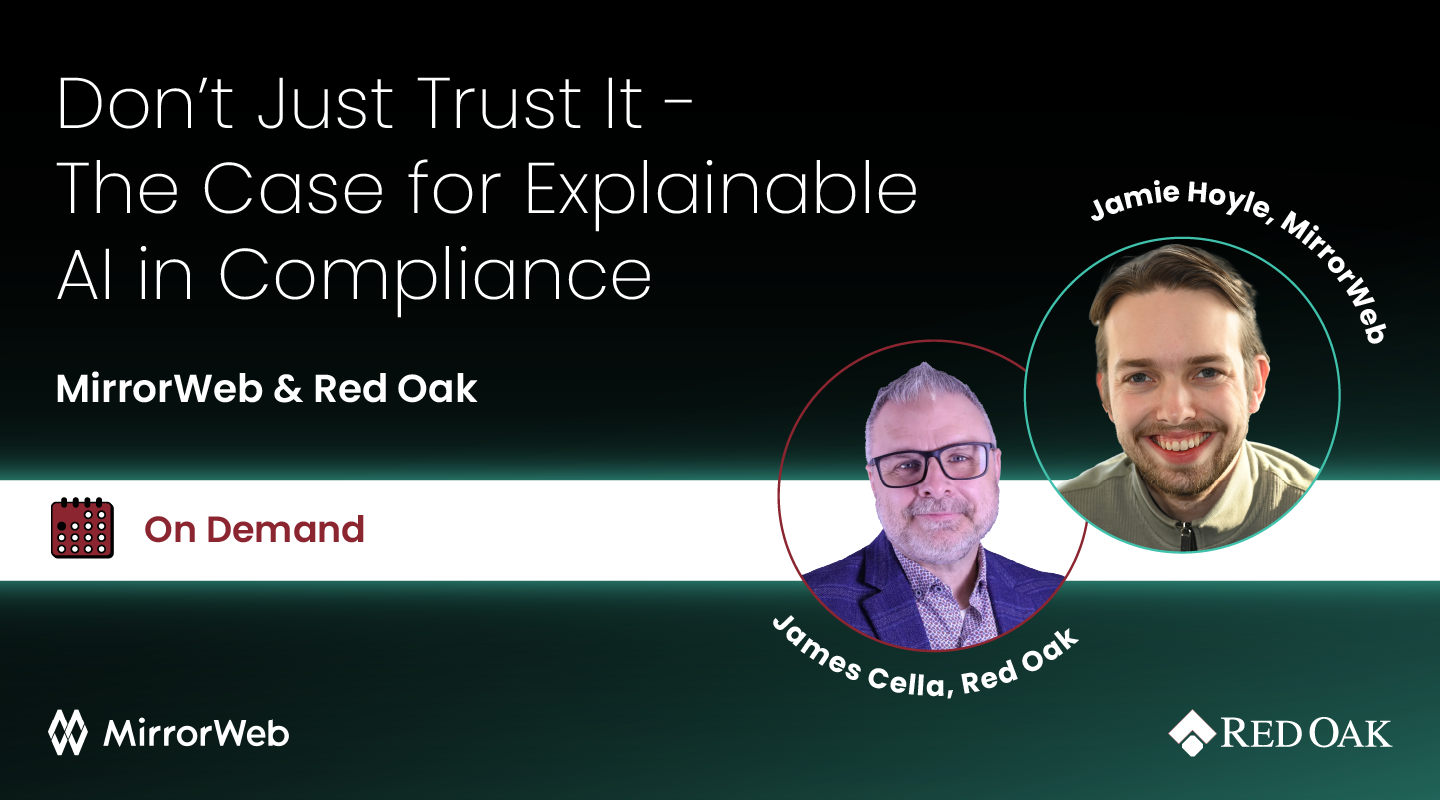
As compliance teams grapple with exponentially growing communication volumes and persistent false positive rates, a critical question emerges: How can AI help without creating new risks? In a joint webinar, MirrorWeb's VP of Product Jamie Hoyle and Red Oak’s Chief Supervision Evangelist James Cella tackled the industry's most pressing AI concerns, revealing why explainable AI isn't just preferred - it's essential.
The session explored the gap between AI confidence (90% of CCOs believe in AI's detection capabilities) and AI trust (only 41% are "very confident"), presenting frameworks for bridging that divide through transparency, governance, and explainable decision-making.
The $232,000 Problem
Jamie opened with stark mathematics: the average mid-market compliance team spends $232,000 annually processing false positives. This isn't the cost of technology - it's the human cost of reviewing alerts that shouldn't exist.
The root cause traces back 20 years. Email-based lexicon systems designed for simple communication channels now struggle with 10-20 times more data across mobile, Teams, Slack, social media, and other platforms. When the same keyword detection approach flags everything containing "guarantee" - from restaurant recommendations to investment promises - compliance teams drown in irrelevant noise.
James reinforced the math with brutal clarity: $542 per supervised employee annually, just for processing false positives. When 70-80% of alerts require dismissal rather than action, organizations face a fundamental efficiency crisis that headcount alone cannot solve.
From Fear to Cautious Optimism
The industry's AI sentiment has shifted dramatically over 18 months. Early reactions ranged from optimism "AI identification is more efficient than random sampling" to alarm "No one is accountable - you can't tell regulators to sue OpenAI".
James noted a clear pattern: compliance professionals who actively test consumer AI platforms like ChatGPT and Claude show cautious optimism, understanding both capabilities and limitations. Those relying solely on vendor promises or industry hype remain more skeptical.
The accountability concern persists. When AI makes compliance decisions, responsibility falls on firms and their compliance teams - not AI providers. This reality demands transparency in how AI systems operate and make decisions.
The Black Box vs. Glass Box Divide
Jamie outlined the critical distinction reshaping AI vendor evaluation. Black box systems provide risk scores without explanation - "This message is flagged as 6.7 risk" with no context about why or how that score was determined.
Glass box AI, by contrast, provides complete transparency:
- Specific policy violations identified
- Highlighted risk language within messages
- Contextual analysis explaining why flagged terms matter
- Clear connections to regulatory requirements
The difference isn't just user experience - it's regulatory defensibility. New SEC and FINRA guidance demand AI governance, transparency, and plain-language explanations of AI decisions. Compliance teams need systems that show their work.
Three Pillars of Compliance-Grade AI
James presented a framework for implementing trustworthy AI in compliance workflows:
-
Decision Reasoning: AI must explain what it flagged and why, connecting decisions to specific policies rather than opaque scoring. Instead of mysterious algorithms, compliance teams see clear reasoning: "Flagged for FINRA Rule 2210 - misleading investment language detected in context of performance claims."
-
Policy Connections: Flags must link directly to relevant regulations and firm policies, creating educational opportunities for submitters and reviewers. This transforms compliance from checkbox exercises into meaningful risk mitigation tied to actual rules.
-
Show Your Work: Complete audit trails documenting prompts, AI responses, and decision logic. Like math homework, AI systems must demonstrate how they reached their conclusions, creating defensible records for regulatory examination.
The Defensibility Test
The ultimate question for any AI system: Could you confidently explain to regulators why and how it works? Jamie shared unanimous feedback from surveyed CCOs - none would stake their reputation on unexplainable AI decisions.
This creates a partnership imperative. Compliance teams need vendors who provide transparency, validation processes, and ongoing collaboration rather than "trust us" black boxes. The goal isn't vendor dependence but vendor partnership in building defensible compliance programs.
Implementation Essentials
James emphasized critical considerations for AI deployment:
-
Core Integration: AI should be built into platform cores, not bolted on as afterthoughts. Integrated systems provide comprehensive efficiency gains rather than marginal improvements to broken processes.
-
Human-in-the-Loop: No one suggests AI should replace human judgment in compliance. The goal is eliminating noise so qualified professionals can focus on genuine risks requiring series-qualified decision-making.
-
Governance Documentation: Whether vendor-provided or internally developed, AI governance must be documented, auditable, and aligned with firm policies and regulatory requirements.
-
Gradual Implementation: Organizations can implement AI selectively, maintaining traditional approaches for sensitive areas while building confidence through controlled deployment.
The Regulatory Reality
The regulatory landscape demands explainable AI. SEC and FINRA guidance requires:
- AI governance and transparency for any AI systems
- Plain-language explanations of AI decisions
- Demonstrable human oversight
- Strong documentation of decision-making processes
The shift is fundamental: from "Did you catch it?" to "Can you explain why you caught it, and how you govern that process going forward?"
Looking Forward
The webinar's core message resonates clearly: In an era of genuine AI capabilities, compliance tools should eliminate problems rather than making them slightly more manageable.
For compliance teams manually reviewing thousands of false positives or sampling small percentages hoping for the best, explainable AI provides comprehensive coverage with focused attention on genuine risks. The technology exists to move beyond checkbox compliance exercises to confident, comprehensive surveillance programs.
The transformation requires vendors committed to transparency, organizations willing to invest in governance, and recognition that AI's greatest value lies not in replacing human judgment but in ensuring that judgment focuses on what actually matters.
As regulatory scrutiny intensifies and communication volumes continue growing, explainable AI isn't just a competitive advantage - it's becoming a compliance necessity.
Watch the complete webinar to explore how explainable AI can transform your compliance program from reactive alert processing to proactive risk management built on transparency, governance, and defensible decision-making.